
Structural Issues in Bath: What Homeowners and Buyers Should Know
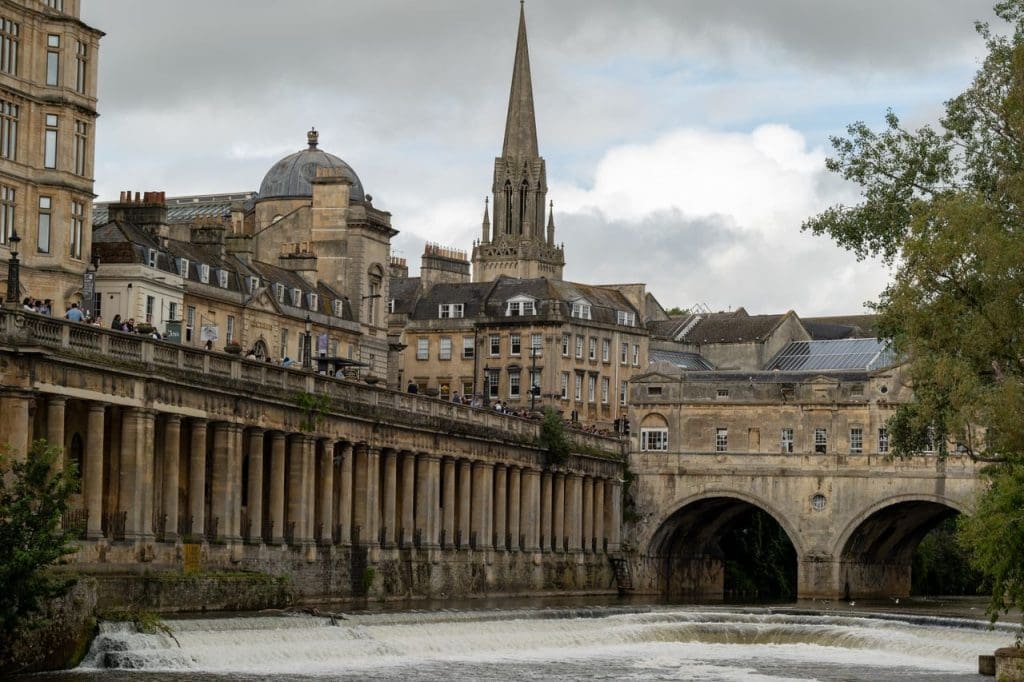
Bath is a beautiful place to own a house and a demanding one to inspect. The city sits in a steep sided valley cut through hard limestone that lies over much weaker clays, and almost everything of structural interest here follows from that one fact. The hillsides move. The stone is soft. The buildings are old, listed, and built to a standard that varied enormously between one speculative developer and the next.
None of that means Bath houses are bad buildings. Most of them have stood for two hundred years and will stand for two hundred more. It does mean that reading cracks in Bath requires a different starting point than reading cracks almost anywhere else.
The hillsides are the story
The valley sides around Bath are steep, and the geology is a heavy limestone cap sitting on soft mudrocks, principally the Fuller’s Earth clay. During the last glaciation those layers deformed on a large scale. The limestone cambered outwards over the softening clay beneath, and several large landslides occurred in the Avon valley. Smaller landslips have since developed within those older features.
This is not remote geological history. One Bath landslip destroyed 135 houses at Hedgemead in the Victorian period, and another is the reason Camden Crescent is famously asymmetric, its eastern end never completed after the ground gave way. Slopes on the Fuller’s Earth around Bath are still capable of slow movement, and monitored sites show that movement tracks rainfall and groundwater levels.
For a homeowner in Bathwick, Widcombe, Lyncombe, Camden or Lansdown, the practical version is this. Cracking on a hillside property is worth understanding properly, because the possible causes range from a settling bay window to slow ground movement on an ancient slip surface, and those two things call for very different responses. Cambered ground can also produce fissures and differential settlement that behave nothing like the classic clay shrinkage patterns that dominate elsewhere.
Bath stone is beautiful and unforgiving
Almost every property in the city centre is faced in Bath stone, an oolitic limestone that was quarried and mined locally. It cuts cleanly, which is why Georgian Bath looks the way it does, and it weathers, erodes and delaminates in ways harder stones do not.
Two recurring issues come with it. The first is the construction itself. Many Georgian facades are a thin ashlar face with rubble stone behind, and the bond between the two is often poor. Over two centuries that face can begin to separate and bow outwards, which looks alarming and sometimes is. The second is repair history. Iron cramps and fixings rust and expand, cement mortar traps moisture against soft stone and accelerates decay, and previous cement repointing is one of the most common contributors to the damage I am asked to look at.
The Combe Down stone mines
Combe Down was mined rather than quarried, with chambers cut into the Bath stone and pillars left to hold the roof. By the twentieth century hundreds of houses stood above workings with very little cover, in places barely two metres. Following surveys in the 1990s a major stabilisation project filled the shallow mines with foamed concrete, and the work was completed in 2009.
That project is one of the reasons Combe Down is a straightforward place to buy today. What it does not do is settle every question about an individual property, particularly where damage predates the stabilisation or where the house sits at the edge of the treated area. Mining questions are answered by searches and records, not by looking at a wall. What an inspection can tell you is whether the cracking in front of us behaves like ground movement at all.
Listed buildings change what a report should say
Bath is a World Heritage Site with several thousand listed buildings and a very active conservation regime. A structural report that recommends the wrong repair is not just unhelpful here, it is unusable, because the work will not get consent.
That shapes how I write. Recommendations need to sit within what conservation officers will accept, which in practice means lime based repairs rather than cement, like for like stone indents, and avoiding the heavy handed interventions that get proposed for buildings of this age. Underpinning in particular is recommended far more often than it is needed.
The Bath buying process, and where I fit
Most enquiries reach me through the same route. A Level 2 or Level 3 survey, or a mortgage valuation, flags cracking and recommends a structural engineer. The sale then sits still until somebody produces a report.
I inspect and report. I do not design repairs, produce calculations or specify remedial work, and I have no relationship with any contractor. That matters most in exactly this situation, because the person telling you whether you need underpinning should not be the person who profits if you do. Most of the time the answer is that you do not.
Reports are issued within 24 hours of the inspection, which is usually what is needed when a chain is waiting.
Areas I cover
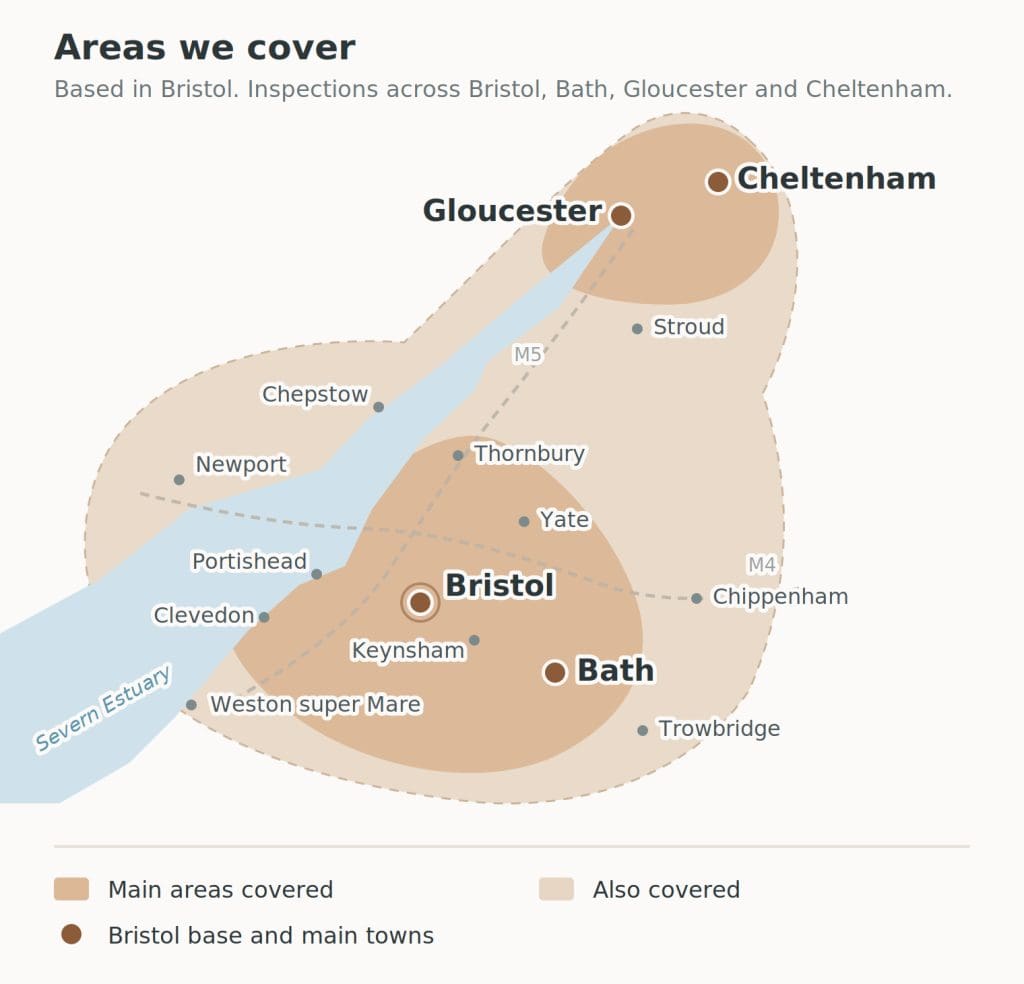
Bath and the surrounding BA postcodes, alongside Bristol, Gloucester and Cheltenham. Bath is around half an hour from my base in Bristol, so availability here is usually the same as in the city, a week or two rather than a month.
Common questions
Is my Bath property at risk of landslip? Slope movement is a real feature of the Bath valley sides, but it affects specific slopes rather than the city generally, and it is slow rather than sudden. If your property is on a hillside and showing cracking, it is worth establishing whether the pattern is consistent with ground movement or with something far more ordinary. It is usually the latter.
Do I need a search for the Combe Down stone mines? If the property is in Combe Down or Odd Down your solicitor will normally deal with this as part of the conveyancing searches, and the stabilisation project completed in 2009 has resolved the underlying problem across the treated area. The search answers the mining question. An inspection answers the question of whether the building is currently moving.
My Georgian facade is bowing outwards. How serious is that? It depends on how much, how fast, and whether the ashlar face is separating from the rubble backing behind it. Some bowing is long standing and stable, and some needs restraint work. This is one of the more common reasons I am called out in Bath, and one where a specific inspection is worth far more than a general opinion.
Does listing affect the report? It affects the recommendations. Any repair to a listed building needs to be appropriate to its construction and acceptable to conservation officers, so there is no point recommending work that will never be consented. The report is written with that in mind.
How quickly can you inspect? Usually one to two weeks, with a faster option when a sale is under pressure. The report follows within 24 hours of the inspection.
Not Sure Which Report You Need?
Whether it’s one crack or a concern about the whole property, we’ll help you find the right report, and give you a fixed-fee quote within one working day.

Fast Quoting,
No-Obligation
Tell us what you're concerned about and we'll come back with a clear quote, no jargon, no pressure, no obligation. You'll know the cost and what's included before you commit to anything.

24-Hour
Reports
Once the inspection's done, you're not left waiting. You'll have your full written report within 24 hours, so you can make a decision and move on, whether that's reassurance or next steps.

Qualified Engineer,
Not a Call Centre
You deal directly with me, a Chartered Structural Engineer (CEng MICE), from quote to inspection to report. No handoffs, no junior inspector standing in.

Plain-Language Reports
No dense technical jargon you need a second opinion to understand. Every report tells you plainly what's causing the problem, how serious it is, and what, if anything, you need to do next.
Ready for Clarity on Your Crack or Structural Concern?
Tell us a bit about what you've noticed and the property, and we'll come back with which report's right for you and a clear, no-obligation quote. We'll then confirm a date and get your report to you within 24 hours of the inspection.
Prefer to call or email?
Call us on 01452 790 887
Or email us here at:
office@lifelysurveyors.co.uk