
Specific Structural Inspection vs General Structural Inspection: Which Is Right for You?
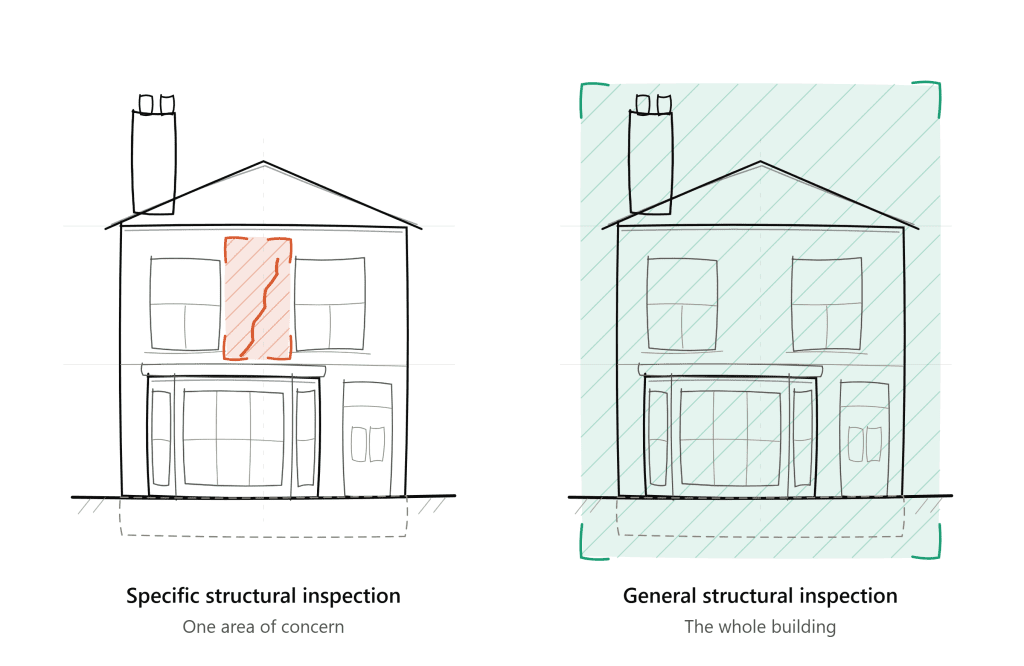
A Specific Structural Inspection examines one defect you already know about, such as a single crack or a leaning wall. A General Structural Inspection assesses the main structural elements of the whole property when you are not sure what is wrong. The simplest test is whether you can point at the problem. If you can, you need the specific report.
The difference in one sentence
Specific Structural Inspection (SSI): a defined question about a defined issue.
General Structural Inspection (GSI): an open question about the whole building.
Everything else follows from that. A house with four cracks that are plainly one mechanism on one elevation is still a specific question, and still an SSI. A house with a single hairline crack, bought by someone who actually wants to know whether the whole structure is sound before they exchange, is an open question, and that is a GSI.
Counting defects creates arguments. Asking what you actually need to know does not.
When the Specific Structural Inspection is right
Choose the SSI when you already know what you are worried about and where it is.
Typical situations:
- A surveyor has flagged one crack or one area and recommended it is looked at
- A mortgage valuer has identified a specific defect and the lender wants it reported on
- You have noticed cracking in one place and want to know whether it matters
- An insurer has asked for a report on damage in one part of the property
- A retaining wall, a bay window, a bulging section of wall, or a crack above an opening
- A garage, an outbuilding or a boundary wall considered on its own
The fee is £570 including VAT, fixed. It does not change with the size of the property or how far the drive is.
When the General Structural Inspection is right
Choose the GSI when the honest answer to “what specifically are you worried about?” is “I am not sure, that is why I am asking.”
Typical situations:
- A Level 2 survey has recommended a structural engineer without naming one particular defect
- You are buying a property in visibly poor condition and want to know the structure is sound before you commit
- Cracking is present in several places and you do not know whether they are related
- You are buying a property with a known history of subsidence and need the whole picture
- You want overall reassurance rather than a diagnosis of one thing
The GSI covers the primary structural elements of the building, meaning the roof structure, the load bearing walls, the floor system and the foundations. Fees start at £720 including VAT and vary with the size of the property. You get the exact figure at quote stage.
Side by side
| Specific Structural Inspection | General Structural Inspection | |
|---|---|---|
| Answers | What is this defect, and does it matter? | Is this building structurally sound? |
| Scope | One defined defect or area | Roof structure, load bearing walls, floors, foundations |
| Best when | You can point at the problem | You cannot point at a specific problem, or you want overall reassurance |
| Fee including VAT | £570, fixed | From £810, varies with property size |
| Time on site | Around 2 hours | Around 2 hours |
| Report turnaround | 24 hours | 24 hours |
Six real situations
“My surveyor’s Level 2 report says there is a diagonal crack to the rear elevation and recommends a structural engineer inspects it.” SSI. The surveyor has done the hard part by identifying what needs looking at.
“My Level 2 report says the property shows signs of movement and I should instruct a structural engineer.” GSI. That wording gives you nothing to point at. It is the most common reason people end up needing the general report, and it catches a lot of buyers out because they assume the surveyor has been specific when they have not.
“There are cracks in the front bedroom, in the hallway, and outside near the bay.” It depends, and this is the case where the counting approach falls apart. If those cracks are all on one elevation and one mechanism is doing all of it, that is one question and an SSI. If they are scattered around the building, that is an open question and a GSI. I can help at the enquiry form stage to provide an honest opinion and quote.
“I am buying a Victorian terrace that has clearly been messed about with over the years. Two extensions, a knocked through ground floor, and I have no idea if any of it had building control.” GSI. Nothing specific has gone wrong. You want to know the structure holds together.
“The lender will not release the offer until an engineer reports on the cracking to the side wall.” SSI. The lender has told you exactly what they want reported on, and that is what the report should address.
“The garden retaining wall is leaning and I want to know if it is about to go.” SSI. Self contained question, self contained answer.
What if you pick the wrong one?
When you fill in the enquiry form, you describe what you are worried about. The quote you receive names the report that fits and explains why.
If you have asked for the SSI and the enquiry describes something too broad to answer with a single defect inspection, you will be told that before you commit rather than discovering it on the day.
What both reports include
- A visual inspection of the property, typically around two hours on site
- Annotated photographs taken during the visit
- A written report identifying what is there, interpreting the cause, and setting out what should happen next
- Delivery within 24 hours of the inspection
- Plain language suitable for a lender, an insurer, a solicitor or a builder to act on
- Follow up clarification if questions come back from any of them
What neither report includes
Both are visual and non invasive inspections. Floors are not lifted, plaster is not removed, and nothing is excavated. Services are not tested.
Both comment on structure only. Damp, timber decay, roof coverings, gutters, windows, doors, finishes and general condition are outside the scope. Neither report is an RICS condition survey and neither is a substitute for one.
Neither includes structural calculations, beam design or a repair specification. This business inspects and reports. It does not design repairs and it does not carry them out, which is the reason a conclusion of “this needs no structural repair” means what it says.
You do not have to decide
The most useful thing you can do is describe the problem in your own words and let the quote sort it out. A photograph of the crack and a sentence about who asked you to get a report will nearly always be enough to identify the right one.
Clarity on cracks and structural movement, within 24 hours.
Frequently asked questions
What is the difference between a Specific and a General Structural Inspection?
A Specific Structural Inspection answers a defined question about a defined defect, such as one crack or one wall. A General Structural Inspection assesses the primary structural elements of the whole building. The difference is the scope of the question, not the number of cracks present.
Can I get a Specific Structural Inspection if I have more than one crack?
Yes, provided the cracks form one question. Several cracks on one elevation caused by one mechanism are a single defect inspection. Cracking scattered across the building without an obvious common cause is a general inspection.
My survey says to instruct a structural engineer but does not say why. Which do I need?
A General Structural Inspection, in almost all cases. Where a surveyor recommends an engineer without identifying a specific defect, there is nothing definite for a specific inspection to address, so the whole structure needs assessing.
Is the General Structural Inspection the same as a structural survey?
The terms get used loosely. A General Structural Inspection is an engineer’s assessment of the primary structural elements only. A structural survey, if what is meant is an RICS Level 3 Building Survey, covers the general condition of the whole property including damp, roof coverings and finishes, and is carried out by a surveyor rather than an engineer.
Which report do lenders and insurers accept?
Both, provided the report addresses what they have asked about. Where a lender or insurer has named a specific defect, a Specific Structural Inspection addressing it is what they want. Where they have raised the overall condition of the structure, a General Structural Inspection is needed.
How much more does the General Structural Inspection cost?
The Specific Structural Inspection is £570 including VAT as a fixed fee. The General Structural Inspection starts at £810 including VAT and rises with property size. Both include the site visit, the inspection and the report, with no separate charges.
Not Sure Which Report You Need?
Whether it’s one crack or a concern about the whole property, we’ll help you find the right report, and give you a fixed-fee quote within one working day.

Fast Quoting,
No-Obligation
Tell us what you're concerned about and we'll come back with a clear quote, no jargon, no pressure, no obligation. You'll know the cost and what's included before you commit to anything.

24-Hour
Reports
Once the inspection's done, you're not left waiting. You'll have your full written report within 24 hours, so you can make a decision and move on, whether that's reassurance or next steps.

Qualified Engineer,
Not a Call Centre
You deal directly with me, a Chartered Structural Engineer (CEng MICE), from quote to inspection to report. No handoffs, no junior inspector standing in.

Plain-Language Reports
No dense technical jargon you need a second opinion to understand. Every report tells you plainly what's causing the problem, how serious it is, and what, if anything, you need to do next.
Ready for Clarity on Your Crack or Structural Concern?
Tell us a bit about what you've noticed and the property, and we'll come back with which report's right for you and a clear, no-obligation quote. We'll then confirm a date and get your report to you within 24 hours of the inspection.
Prefer to call or email?
Call us on 01452 790 887
Or email us here at:
office@lifelysurveyors.co.uk