
What Do Diagonal Cracks in Brickwork Mean?
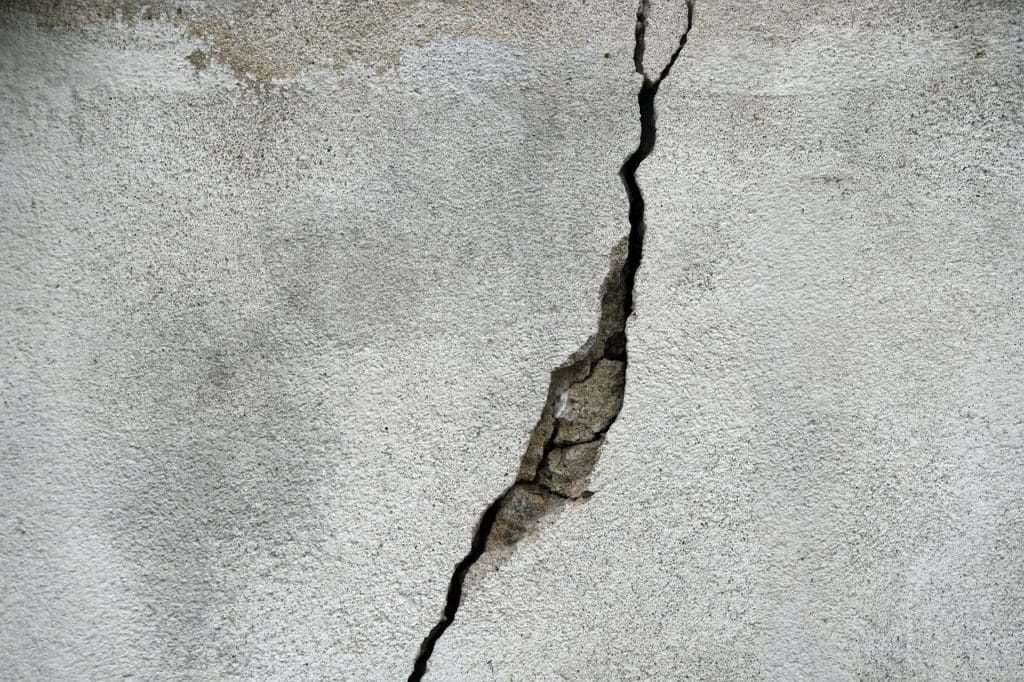
Diagonal cracks in brickwork are usually caused by differential movement in the foundations, meaning one part of the building has moved more than another. The crack runs diagonally because it follows the weakest path through the mortar joints. Not all diagonal cracks are serious. Width, location and whether the crack is still moving determine whether repair is needed.
Why cracks run diagonally
A brick wall is not one solid thing. It is a grid of strong units held together by comparatively weak mortar. When something below the wall moves, the wall has to accommodate that movement somewhere, and it does so along the line of least resistance.
That line is almost never straight through the bricks. It runs up through a vertical joint, along a bed joint, up through the next vertical joint, and so on. The result is the familiar stepped or staircase pattern that reads as a diagonal across the elevation.
This matters more than it sounds. A crack that steps neatly through the mortar is telling you the bricks themselves are still intact and the wall is moving as a unit. A crack that runs straight through the bricks rather than around them means the force involved was greater than the strength of the brick, which is a more significant finding.
The three most common causes
- Foundation movement (subsidence, settlement, heave) – This is the cause most people fear and the one behind the majority of the diagonal cracking I am called out to inspect. It splits into three types that are often confused with each other.
- Lintel failure over openings – If your diagonal crack starts at the top corner of a window or door and runs upwards and outwards, look at the lintel rather than the ground. A lintel that has corroded, deflected or was never adequate for the span will drop slightly, and the masonry above it redistributes its load out to either side. The cracks appear at roughly forty five degrees from the corners of the opening, sometimes with a horizontal crack directly beneath. This is a common finding in properties from the 1960s onwards where steel lintels were used, and in older properties where a timber lintel has decayed behind the render.
- Thermal and moisture movement – Masonry expands and contracts. Long unbroken runs of brickwork, parapet walls, and anything rendered are all prone to cracking simply from seasonal temperature and humidity change, particularly where no movement joint was provided. The signature here is a crack that visibly opens in winter and closes in summer, or the reverse. It stays within a narrow width band and it does not progressively worsen year on year. Cracking of this kind is very rarely structurally significant, although it can let water in and should still be sealed.
What the crack is telling you
Before assuming the worst, there are five things worth looking at. None of them replace an inspection, but together they will tell you roughly how concerned to be.
Width – The industry uses BRE Digest 251, which sets out categories of damage from negligible through to very severe. In plain terms, hairline cracking below about 1mm is generally cosmetic. Cracking up to around 5mm is usually easily filled and repaired. Once a crack exceeds roughly 5mm, or several cracks of that width appear together, it moves into territory where the cause needs to be properly established before anything is repaired.
Taper – Foundation movement cracks are almost always wider at one end than the other, because the wall is rotating rather than simply pulling apart. A crack wider at the top usually indicates movement downward at the far side of the crack. A crack wider at the base points to a different mechanism. A crack of uniform width along its whole length often has a thermal or shrinkage origin.
Path – As above, a crack that steps through the mortar joints is a different finding from one that fractures the bricks themselves.
Internal and external – If a crack is visible on the outside of the wall and again on the inside in the same position, it passes through the full thickness of the structure. That is a more significant finding than a crack visible on one face only, which may be limited to render, plaster or the outer leaf.
Whether it is still moving – This is the single most useful piece of information and the hardest to establish from one visit. Fresh cracking has clean, sharp edges and exposed unweathered mortar. Historic cracking that has stopped tends to be dirty, filled with debris, or previously decorated over. Where it genuinely cannot be determined, monitoring over a period of months is the correct answer rather than a guess.
When to worry, and when not to
Most of the cracks I inspect are not a threat to the building.
Fine cracking where two different materials meet, around the edges of an extension, at a change in wall thickness, or through render on an otherwise sound wall, is usually movement doing exactly what it should. Filling and redecorating is often the only recommendation.
The findings that do warrant attention are cracks wider than about 5mm, cracks that have visibly grown over a period of months, cracks accompanied by doors and windows sticking or floors sloping, and any diagonal cracking that appears at the same time as a nearby tree, a drainage problem or building work next door.
What happens next
If you want a diagonal crack looked at properly, the inspection is straightforward. I attend the property, examine the crack internally and externally along with the surrounding structure, look at the wider context including drainage, vegetation and ground levels, and take photographs throughout. A typical visit takes around two hours.
You then receive a written report within 24 hours of the inspection. It describes what is there, interprets the cause, and sets out what should be done next, in language you can hand to a builder, a lender, an insurer or a solicitor without needing it translated
Not Sure Which Report You Need?
Whether it’s one crack or a concern about the whole property, we’ll help you find the right report, and give you a fixed-fee quote within one working day.

Fast Quoting,
No-Obligation
Tell us what you're concerned about and we'll come back with a clear quote, no jargon, no pressure, no obligation. You'll know the cost and what's included before you commit to anything.

24-Hour
Reports
Once the inspection's done, you're not left waiting. You'll have your full written report within 24 hours, so you can make a decision and move on, whether that's reassurance or next steps.

Qualified Engineer,
Not a Call Centre
You deal directly with me, a Chartered Structural Engineer (CEng MICE), from quote to inspection to report. No handoffs, no junior inspector standing in.

Plain-Language Reports
No dense technical jargon you need a second opinion to understand. Every report tells you plainly what's causing the problem, how serious it is, and what, if anything, you need to do next.
Ready for Clarity on Your Crack or Structural Concern?
Tell us a bit about what you've noticed and the property, and we'll come back with which report's right for you and a clear, no-obligation quote. We'll then confirm a date and get your report to you within 24 hours of the inspection.
Prefer to call or email?
Call us on 01452 790 887
Or email us here at:
office@lifelysurveyors.co.uk